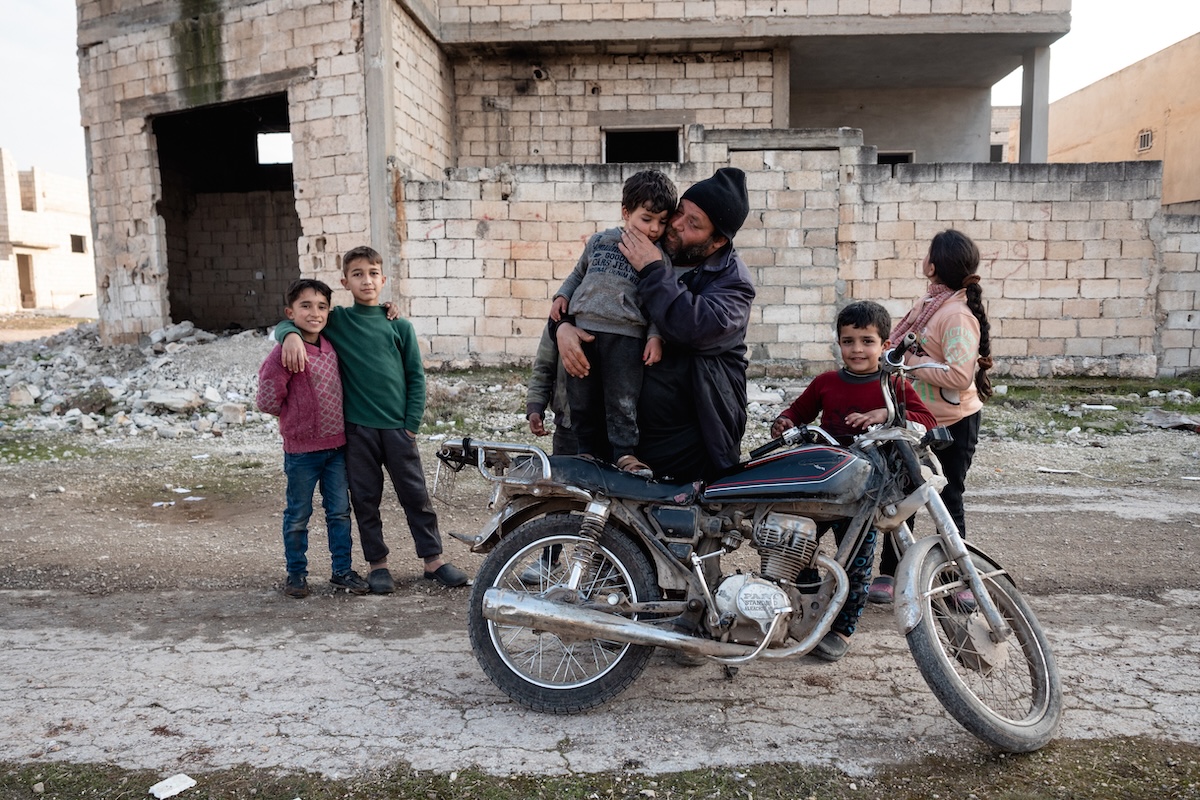
Traveling through Syria by motorcycle is still largely undocumented, especially in recent years. Many travelers report spending weeks searching for reliable information without finding anything useful.
This report is based on real experiences and aims to provide practical details for future riders, mainly by Luke and Jordi from our traveler community.
Have questions about visa requirements, getting a SIM card, handling money, finding accommodations, or discovering the best places to visit and work?
Check out our ultimate Syria travel guide (updated for 2026)!
This report is based on real experiences and aims to provide practical details for future riders, mainly by Luke and Jordi from our traveler community.
Have questions about visa requirements, getting a SIM card, handling money, finding accommodations, or discovering the best places to visit and work?
Check out our ultimate Syria travel guide (updated for 2026)!
Border crossings with a motorcycle
Entering Syria from Jordan
Traveling with your own vehicle is very different from crossing by public transport. In addition to the visa, motorcycles entering Syria are subject to an additional vehicle fee. Travelers have reported different amounts depending on the border and circumstances, ranging from around 50 to 100 USD for a motorcycle. Some travelers reported that the fee covers a limited period of stay, with fines applied if overstaying.
The Syrian side of the border is described as one of the easiest encountered during several months of travel. The process was fast and straightforward.
By contrast, the Jordanian side was slower and more complicated. A carnet de passage was not requested. In general, the process on the Syrian side was simple, with no major additional requirements
The Syrian side of the border is described as one of the easiest encountered during several months of travel. The process was fast and straightforward.
By contrast, the Jordanian side was slower and more complicated. A carnet de passage was not requested. In general, the process on the Syrian side was simple, with no major additional requirements
Exiting Syria and crossing into Iraq
Experience from Jordi
The exit from Syria and entry into Iraq was done via the Al-Bukamal border crossing Syria-Iraq: one of the most complex border experience experienced !
The Syrian exit was very fast, but the Iraqi side was extremely slow and complicated, taking more than five hours.
Travelers are moved between multiple offices, asked many questions, and sometimes mistaken for military personnel when traveling alone by motorcycle. The process reflects a lack of structure and communication, and some travelers report requests for unofficial payments at customs due to the low number of crossings.
Currency is another issue: only Iraqi dinars are accepted, with no exchange available at the border, which can be problematic if not prepared. English is generally not spoken, adding a further barrier.
Both the border area and surrounding regions carry a strong perception of insecurity, and many advise against crossing at night. In reality, long delays make it difficult to complete the journey in daylight anyway, with a typical day starting at sunrise and ending around 10 p.m. in Ramadi.
The road from Deir ez-Zor to the border is in very poor condition. The 130 km stretch takes three to four hours, passes through sensitive areas, and runs alongside the river. There are frequent checkpoints and increased attention, especially for solo motorcyclists. Finally, while the road from Ramadi to the border is in excellent condition(among the best in Iraq) checkpoints in this area are described as stricter and more unpredictable than elsewhere in the country.
The exit from Syria and entry into Iraq was done via the Al-Bukamal border crossing Syria-Iraq: one of the most complex border experience experienced !
The Syrian exit was very fast, but the Iraqi side was extremely slow and complicated, taking more than five hours.
Travelers are moved between multiple offices, asked many questions, and sometimes mistaken for military personnel when traveling alone by motorcycle. The process reflects a lack of structure and communication, and some travelers report requests for unofficial payments at customs due to the low number of crossings.
Currency is another issue: only Iraqi dinars are accepted, with no exchange available at the border, which can be problematic if not prepared. English is generally not spoken, adding a further barrier.
Both the border area and surrounding regions carry a strong perception of insecurity, and many advise against crossing at night. In reality, long delays make it difficult to complete the journey in daylight anyway, with a typical day starting at sunrise and ending around 10 p.m. in Ramadi.
The road from Deir ez-Zor to the border is in very poor condition. The 130 km stretch takes three to four hours, passes through sensitive areas, and runs alongside the river. There are frequent checkpoints and increased attention, especially for solo motorcyclists. Finally, while the road from Ramadi to the border is in excellent condition(among the best in Iraq) checkpoints in this area are described as stricter and more unpredictable than elsewhere in the country.
Another traveler experience - Luke
He reported attempting several different exits from Syria towards Iraq and Turkey. The planned exit through Bab al-Hawa towards Turkey was never approved, forcing a change of plans.
Another attempt through Semalka was refused by Syrian authorities. At Rabia, the crossing was delayed because Iraqi authorities could not issue the required visa sticker. The traveler was redirected to Al-Qaim, where after several hours officials advised returning due to security concerns.
After returning approximately 400 km back to Rabia, the crossing was eventually possible, but only after waiting for the necessary equipment to print the Iraqi visa sticker. This highlights how unpredictable some border crossings can be for overland travelers, even when official crossings are open.
He reported attempting several different exits from Syria towards Iraq and Turkey. The planned exit through Bab al-Hawa towards Turkey was never approved, forcing a change of plans.
Another attempt through Semalka was refused by Syrian authorities. At Rabia, the crossing was delayed because Iraqi authorities could not issue the required visa sticker. The traveler was redirected to Al-Qaim, where after several hours officials advised returning due to security concerns.
After returning approximately 400 km back to Rabia, the crossing was eventually possible, but only after waiting for the necessary equipment to print the Iraqi visa sticker. This highlights how unpredictable some border crossings can be for overland travelers, even when official crossings are open.
Exiting Syria to Lebanon
Another border crossing was made from Syria into Lebanon via the Jousieh border.
The entire process took approximately 1 hour and 45 minutes.
On the Syrian side, the exit took around 38 minutes, with a 5 USD vehicle exit fee. Immigration was quick, and baggage was briefly checked. Officials showed curiosity due to the low number of foreign travelers but the process remained smooth overall.
On the Lebanese side, the process took around one hour, mainly due to administrative steps. Travelers must purchase insurance (around 35 USD for one year, with no short-term option), pay a 12 USD entry sticker, and provide a passport copy for a small fee. At customs, a 50 USD fee is required for motorcycle entry for three months if no carnet de passage is available. All payments are made in USD.
The total cost was approximately 102.50 USD.
The entire process took approximately 1 hour and 45 minutes.
On the Syrian side, the exit took around 38 minutes, with a 5 USD vehicle exit fee. Immigration was quick, and baggage was briefly checked. Officials showed curiosity due to the low number of foreign travelers but the process remained smooth overall.
On the Lebanese side, the process took around one hour, mainly due to administrative steps. Travelers must purchase insurance (around 35 USD for one year, with no short-term option), pay a 12 USD entry sticker, and provide a passport copy for a small fee. At customs, a 50 USD fee is required for motorcycle entry for three months if no carnet de passage is available. All payments are made in USD.
The total cost was approximately 102.50 USD.
Fuel, checkpoints, and general travel conditions
Main roads in Syria are generally in good condition. Routes connecting major cities such as Damascus, Homs, Hama, Aleppo, Latakia and Tartus are mostly smooth. Even access to Palmyra is relatively easy. Riding there is particularly enjoyable, as there are few restrictions once inside the area.
However, conditions inside cities can be very different. Roads are sometimes heavily damaged, especially in places like Homs. Navigation is also unreliable, as Google Maps often shows roads that do not exist or misses others entirely.
Fuel is generally easy to find in Syria, although some stations shown on Google Maps do not actually exist. Alternatives are usually available nearby.
Checkpoints vary significantly. Although many travelers expect checkpoints to be concentrated only in eastern Syria, motorcycle travelers report being stopped throughout the country. In many cases, soldiers simply check documents and wave travelers through.
However, between Palmyra, Deir ez-Zor, and the Iraqi border, checkpoints become more frequent and involve more questioning due to the sensitivity of the region.
Within approximately 15 km of the Iraqi border, travelers report increased attention, with more frequent stops and additional questions, especially for solo motorcycle travelers.
However, conditions inside cities can be very different. Roads are sometimes heavily damaged, especially in places like Homs. Navigation is also unreliable, as Google Maps often shows roads that do not exist or misses others entirely.
Fuel is generally easy to find in Syria, although some stations shown on Google Maps do not actually exist. Alternatives are usually available nearby.
Checkpoints vary significantly. Although many travelers expect checkpoints to be concentrated only in eastern Syria, motorcycle travelers report being stopped throughout the country. In many cases, soldiers simply check documents and wave travelers through.
However, between Palmyra, Deir ez-Zor, and the Iraqi border, checkpoints become more frequent and involve more questioning due to the sensitivity of the region.
Within approximately 15 km of the Iraqi border, travelers report increased attention, with more frequent stops and additional questions, especially for solo motorcycle travelers.
Focus on Eastern Syria: Deir ez-Zor Region
The most difficult internal section is the route between Deir ez-Zor and the Iraqi border. The road is severely damaged, slow, and passes through multiple villages. It runs along a river that is considered a sensitive dividing line. This area requires extra attention due to frequent checkpoints and the overall atmosphere.
Because of the combination of poor road conditions, isolation, checkpoints, and the proximity to the Iraqi border, this section requires more planning and flexibility than other parts of the country.
Because of the combination of poor road conditions, isolation, checkpoints, and the proximity to the Iraqi border, this section requires more planning and flexibility than other parts of the country.
Accommodation and motorcycle parking
Check all the accommodation options in Syria in our dedicated article.
One of the main challenges in Syria is parking a motorcycle safely.
One of the main challenges in Syria is parking a motorcycle safely.
- In Homs, Johnny’s Hostel Homs has no parking, but the owner is extremely helpful and finds solutions when possible.
- In Aleppo, accessing hotels with a large motorcycle can be extremely difficult due to narrow souq streets. Dar Halabia Hotel Aleppo may appear suitable, but in practice it is very difficult to reach with a motorcycle.
- In Latakia, Safwan Hostel Latakia does not have parking but staff can help arrange safe storage.
- In Damascus, Al Haramain Hotel Damascus offers secure parking.
- In Deir ez-Zor, Albostan Hotel Deir ez-Zor provides safe parking and is one of the only available options in the area.
Final thoughts
Despite logistical difficulties, border complexity, and occasional uncertainty, traveling through Syria by motorcycle is widely described as an incredible experience. The country is defined by its landscapes, its unpredictability, and above all the hospitality of its people.
For motorcycle travelers, preparation is key: border information changes quickly, and having recent reports from other riders can make a significant difference. Online communities such as iOverlander and overlanding groups have become essential tools for planning these journeys.
For travelers crossing the region with their own vehicle, overlanding Facebook groups can be a valuable source of updated information:
• Overlanding group 1: https://www.facebook.com/share/g/1BbLGS5G1f/?mibextid=wwXIfr
• Overlanding group 2: https://www.facebook.com/share/g/1EPg185JQJ/?mibextid=wwXIfr
For those traveling through the region (whether by motorcycle, public transport, or other means), this WhatsApp group is also a useful place to exchange information, ask questions, and connect with other travelers:
https://chat.whatsapp.com/CPVew6PjnB36Yl6oZU6E5W?s=cl&p=a&mlu=3
For motorcycle travelers, preparation is key: border information changes quickly, and having recent reports from other riders can make a significant difference. Online communities such as iOverlander and overlanding groups have become essential tools for planning these journeys.
For travelers crossing the region with their own vehicle, overlanding Facebook groups can be a valuable source of updated information:
• Overlanding group 1: https://www.facebook.com/share/g/1BbLGS5G1f/?mibextid=wwXIfr
• Overlanding group 2: https://www.facebook.com/share/g/1EPg185JQJ/?mibextid=wwXIfr
For those traveling through the region (whether by motorcycle, public transport, or other means), this WhatsApp group is also a useful place to exchange information, ask questions, and connect with other travelers:
https://chat.whatsapp.com/CPVew6PjnB36Yl6oZU6E5W?s=cl&p=a&mlu=3
Don’t forget to check out our complete Syria Travel Guide, where you’ll find all the practical information you need to prepare your journey, including visa requirements, border crossings, transportation, SIM cards, money, accommodation, safety tips, and much more.
And if you are looking for inspiration for your itinerary, discover our guide to the best places to visit in Syria, featuring the country’s most fascinating cities, historical sites, and hidden gems.
And if you are looking for inspiration for your itinerary, discover our guide to the best places to visit in Syria, featuring the country’s most fascinating cities, historical sites, and hidden gems.